Two scientists with deep ties to the Borlaug Global Rust Initiative (BGRI) received major honors from the American Phytopathological Society (APS) for advancing plant disease research and strengthening agricultural systems worldwide.
Ravi Prakash Singh, a distinguished scientist emeritus and senior advisor at the International Maize and Wheat Improvement Center (CIMMYT), received the 2026 APS Award of Distinction, the society’s highest honor. Maricelis Acevedo, research professor at Cornell University and director for science of the BGRI, received the 2026 Excellence in International Service Award. The awards were presented August 2 during Plant Health 2026 in Providence, Rhode Island.
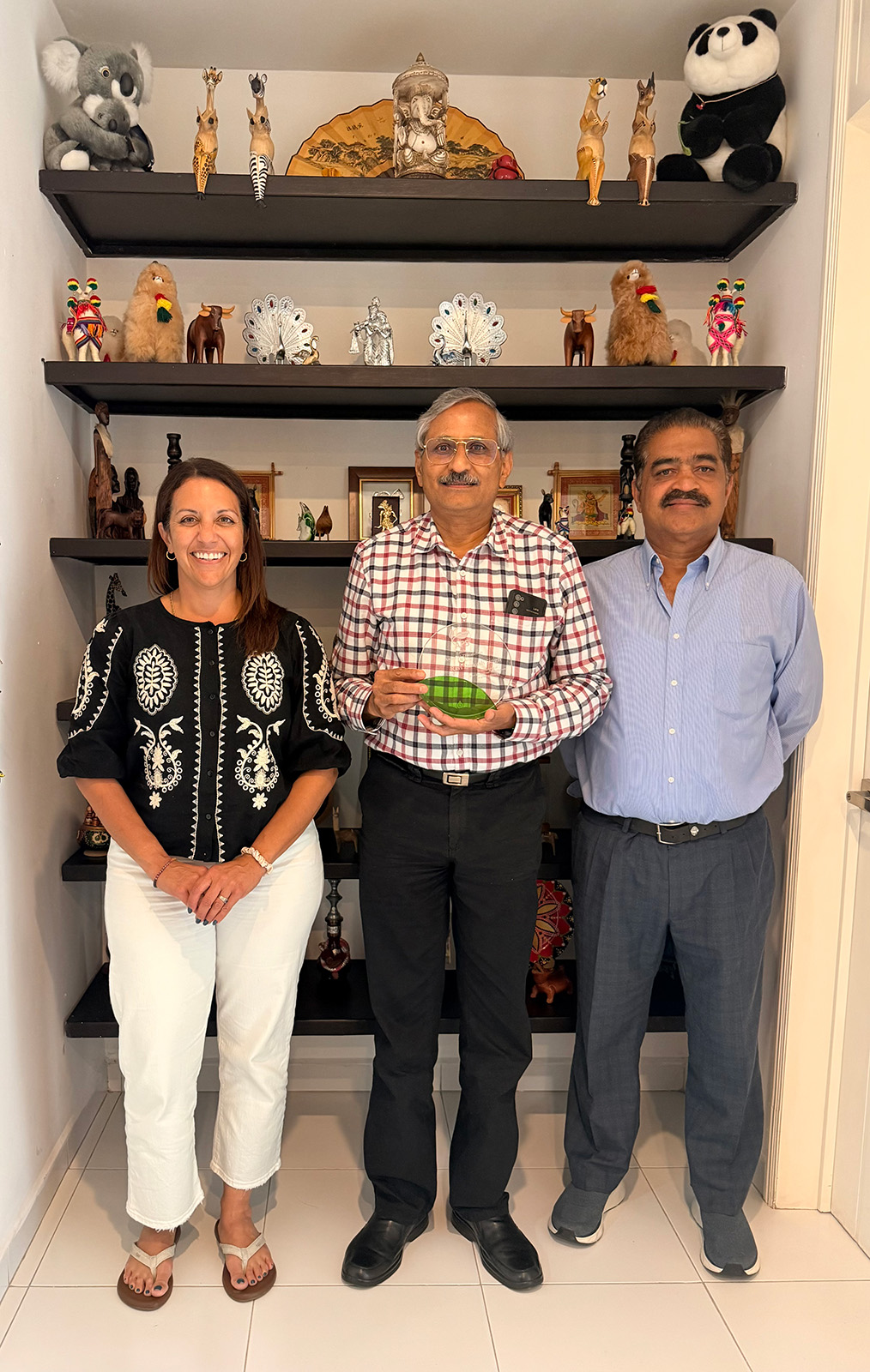
Ravi Singh (center) with Maricelis Acevedo and Pawan Kumar Singh, co-leaders of the Global Wheat Health Alliance
Singh was recognized for nearly four decades of research and leadership that fundamentally changed how wheat breeders protect crops from rust diseases and other major threats. His work helped establish durable, race-nonspecific resistance as a cornerstone of modern wheat breeding. APS credited him with demonstrating that combinations of multiple slow-rusting genes could provide high levels of protection that remain effective over time.
His research became especially important following the emergence of Ug99, a highly virulent strain of wheat stem rust first detected in East Africa. Singh worked closely with Norman Borlaug and international partners to help establish the BGRI and led efforts at CIMMYT to develop and distribute wheat lines carrying durable resistance to multiple rust diseases. Those lines became the foundation for resistant varieties grown across Africa, Asia and the Middle East.
The scale of Singh’s contributions extends well beyond rust resistance. According to APS, he directly contributed to the development of 798 wheat varieties released in 50 countries. His work on durable resistance is estimated to have increased wheat production by more than 250 million tons while helping protect the livelihoods of approximately 30 million smallholder farmers. He also led breeding efforts to address wheat blast, micronutrient deficiencies and heat stress, and trained more than 600 scientists through CIMMYT wheat improvement programs.
Acevedo received the Excellence in International Service Award, which recognizes APS members who have made exceptional contributions to plant pathology outside their own countries. Her career has centered on building partnerships that connect plant disease research with the national programs responsible for protecting crops and supporting farmers.
At Cornell, Acevedo has led international research and education programs across sub-Saharan Africa, South Asia and Latin America. These collaborations have strengthened plant pathology and breeding capacity, supported the development of disease-resistant wheat and insect-resistant eggplant varieties, and helped establish disease surveillance systems used to identify and respond to emerging crop threats. APS also cited her direct training of more than 200 scientists from developing countries, many of whom have since taken leadership positions in their national agricultural programs.
Acevedo currently serves as director for science of the BGRI and co-leads the Global Wheat Health Alliance, an international partnership focused on strengthening resistance to major wheat diseases and ensuring that advances in research reach breeding programs and farmers in vulnerable regions.
Her connection to the BGRI spans much of her career. In 2010, Acevedo was among the early recipients of the BGRI WIT Early Career Award, created to recognize and support emerging scientists working in wheat. She later led training and capacity-development efforts through major BGRI programs before assuming her current scientific leadership role.
Together, the APS honors recognize two generations of leadership within the international wheat community. Singh helped build the scientific foundation and global partnerships that transformed the response to wheat rust. Acevedo helped extend that model by connecting research, surveillance and capacity development across countries facing shared crop disease threats.