Laura Mathieu, a 2025 Jeanie Borlaug Laube WIT Awardee, presented doctoral research on wheat disease to an international scientific audience in Barcelona, Spain, with support from the Borlaug Global Rust Initiative to broaden the reach and impact of wheat disease research beyond traditional disciplinary boundaries.
The Jeanie Borlaug Laube WIT Award supports early-career researchers working in wheat by enabling professional development opportunities such as international conference participation. Mathieu presented research from her doctoral work at the Plant Health Institute of Montpellier (INRAE), with BGRI support enabling her participation in the conference.
By Laura Mathieu, a postdoctoral researcher at Agroscope and the University of Zurich
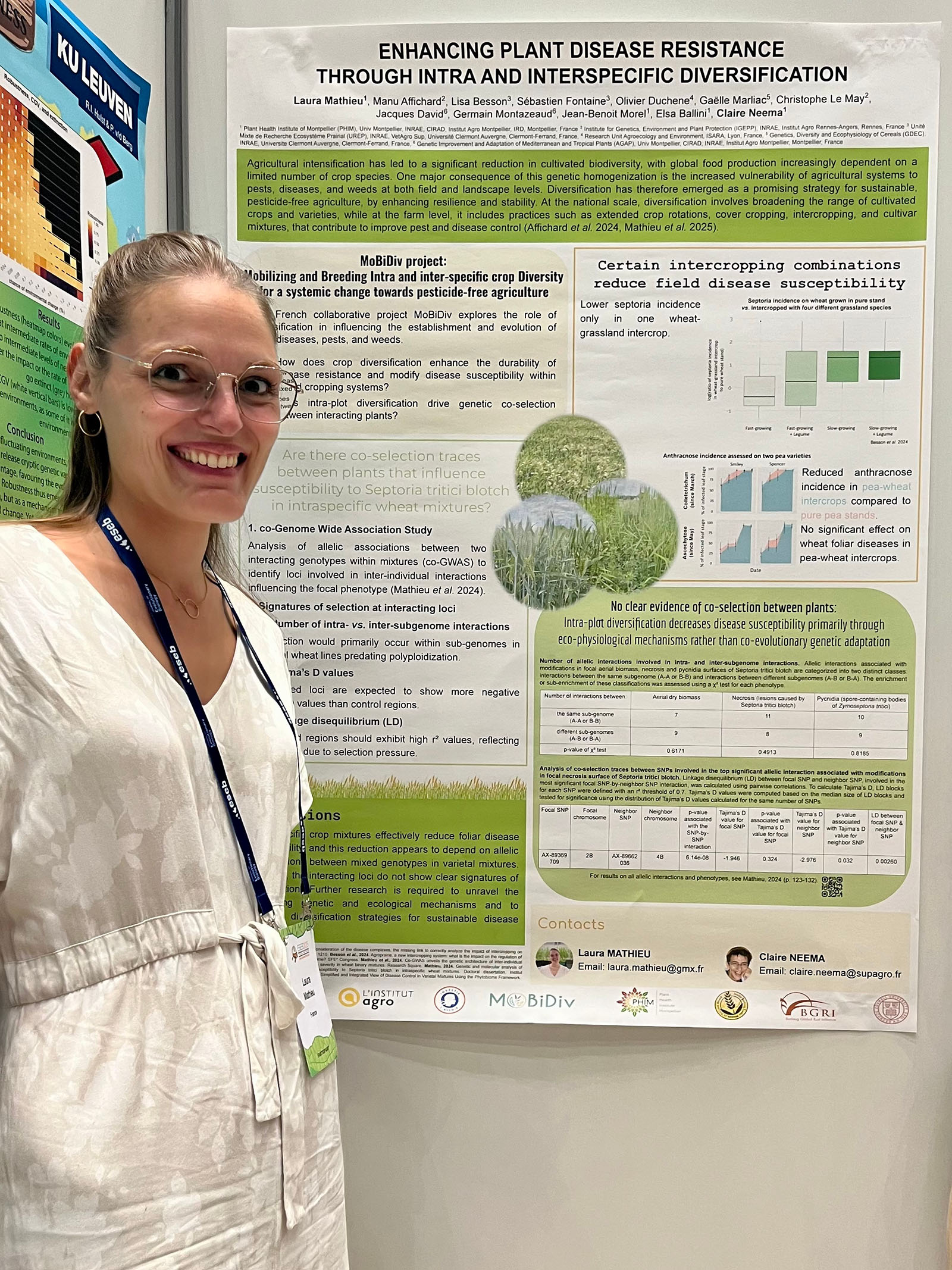
Presentation of my poster during the poster session at ESEB 2025.
At the 2025 Congress of the European Society for Evolutionary Biology (ESEB) in Barcelona, I presented part of the work I completed during my Ph.D. at the Plant Health Institute of Montpellier (INRAE), in France. My doctoral research aimed to understand how increasing biodiversity in agricultural systems can reduce disease pressure and contribute to more sustainable, pesticide-free farming. More specifically, I examined how interactions between plants modulate their susceptibility to diseases in wheat cultivar mixtures, focusing on Septoria tritici blotch, one of the most damaging wheat diseases in Europe.
Why crop diversity matters for disease management
The intensification of agriculture has significantly reduced cultivated biodiversity, with global food production increasingly dependent on a limited number of species. This trend contributes to climate change, biodiversity loss, and human health concerns. A major consequence of crop genetic homogenization is that agricultural systems have become more vulnerable to pests, diseases, and weeds. In contrast, diversification has emerged as a promising strategy for sustainable, pesticide-free agriculture by enhancing resilience and stability.
At the farm level, techniques such as extended crop rotations, cover cropping, intercropping, and cultivar mixtures can improve pest and disease control. In France, mixtures of bread wheat cultivars represented 18% of the total wheat area sown in the 2023–2024 season. Wheat is the most widely produced cereal in France and the second most produced worldwide, yet fungal diseases regularly cause major yield losses—up to 50% in the case of Septoria tritici blotch.
Current control strategies mainly rely on fungicides and resistance genes, both of which are subject to erosion due to the rapid evolution of pathogens. For this reason, it is essential to better understand alternative and more durable mechanisms of disease suppression, such as those occurring in crop mixtures.
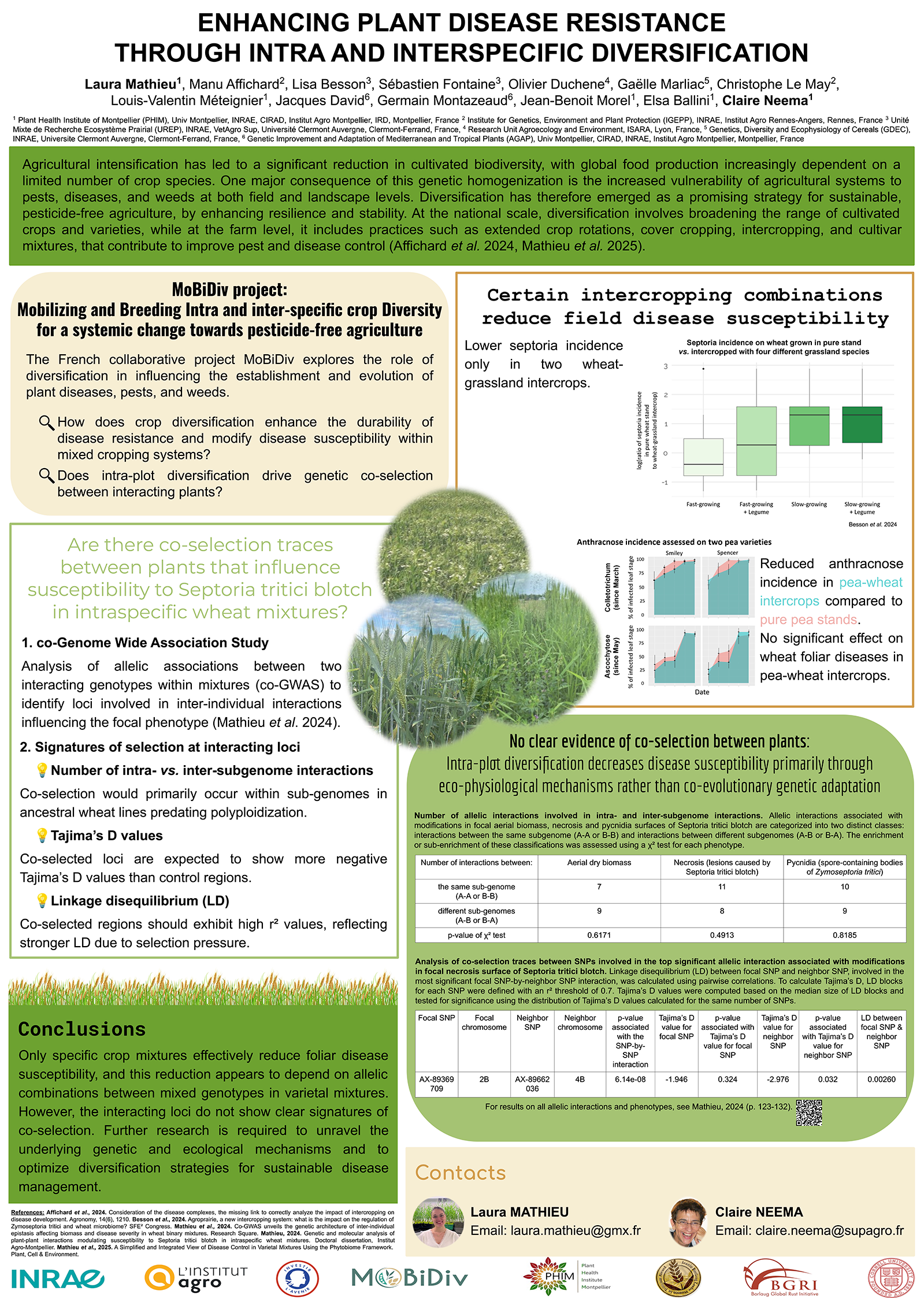
Poster presented at ESEB 2025. Reference: Mathieu, Laura, et al. “Enhancing plant disease resistance through intra and interspecific diversification.” Congress of the European Society for Evolutionary Biology (ESEB 2025). 2025. https://hal.science/hal-05218648.
Studying plant–plant interactions in wheat mixtures
In this context, the objective of my project was to understand how interactions between plants within cultivar mixtures influence wheat susceptibility to Septoria tritici blotch, with the long-term goal of optimizing the design of more resistant mixtures. We confirmed that reductions in disease observed in varietal mixtures may result not only from the slowing of epidemics, but also from plants influencing each other’s susceptibility.
To explore the genetic basis of these interactions, we conducted a co–genome-wide association study (co-GWAS) between interacting plants, a novel approach designed to detect loci involved in inter-individual interactions modulating plant susceptibility to Septoria tritici blotch. While we identified multiple significant allelic interactions, we did not find clear evidence of co-selection between these interacting loci.
This negative result is informative. It suggests that intra-plot diversification influences disease suppression primarily through eco-physiological mechanisms, rather than through co-evolutionary genetic selection. Understanding these mechanisms is essential for improving diversification strategies and resistance management in wheat.
Sharing the work with an international audience
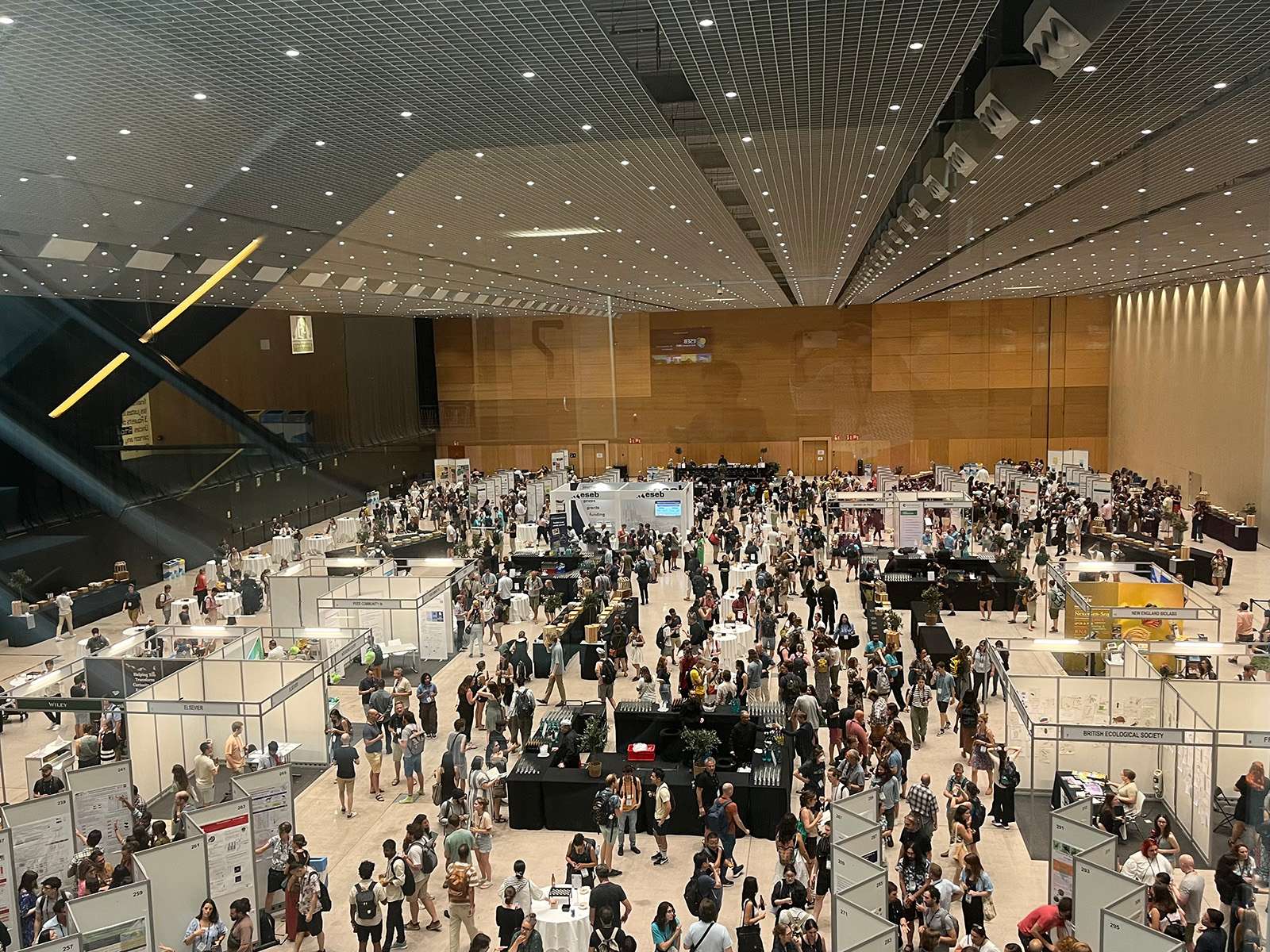
View of the hall including stands, posters and coffee/lunch break area.
ESEB 2025 was the first time I presented these results to an international audience. I had the opportunity to present twice—once in the session “Evolutionary biology meets genetic pest control” and again in a dedicated co-evolution symposium. These experiences were highly complementary: the broader ESEB audience raised conceptual questions, while the co-evolution community provided detailed methodological and interpretive feedback. Many of the attendees were internationally recognized experts in evolution, plant-pathogen interactions, and co-evolution. Their interest, questions, and feedback made the experience incredibly rewarding and encouraging.
A particular highlight of ESEB was the diversity of topics, which spanned humans, animals, plants, and microorganisms. Despite the diversity of organisms, the underlying approaches of ecology, evolution, genomics and molecular biology were deeply interconnected. It was inspiring to see how concepts and methods developed in animal research could shed light on plant–plant interactions.
The conference also reinforced the immense value of connecting with scientists from different disciplines and countries. Conversations during parallel and poster sessions, and at coffee breaks introduced me to new techniques, alternative perspectives, and potential collaborations. Such exchanges can transform your career, especially when they lead to new partnerships that accelerate scientific progress.
Looking ahead
I am deeply grateful to the Borlaug Global Rust Initiative for supporting my participation in ESEB 2025 through the Jeanie Borlaug Laube WIT Award. The conference broadened my scientific perspective, strengthened my confidence, and opened new professional connections. As I move forward, I aim to contribute to sustainable agricultural solutions that strengthen wheat resilience while preserving biodiversity and natural resources.